
Incident Response Planning for Michiana SMBs: Tabletop Exercises That Turn Policy Into Protection
Why Incident Response Planning Matters More for Michiana SMBs
For small and mid-sized businesses in Michiana, incident response planning can no longer live only in a binder or shared folder. Cyberattacks are moving faster, ransomware is becoming more convincing with AI-generated phishing and social engineering, and many supply chain partners now expect proof that vendors can respond quickly to a security event.
That means a written incident response plan is still important—but it is only the starting point. To reduce downtime, protect customer trust, and stay competitive for contracts, Michiana SMBs need to practice how they will respond when something actually goes wrong.
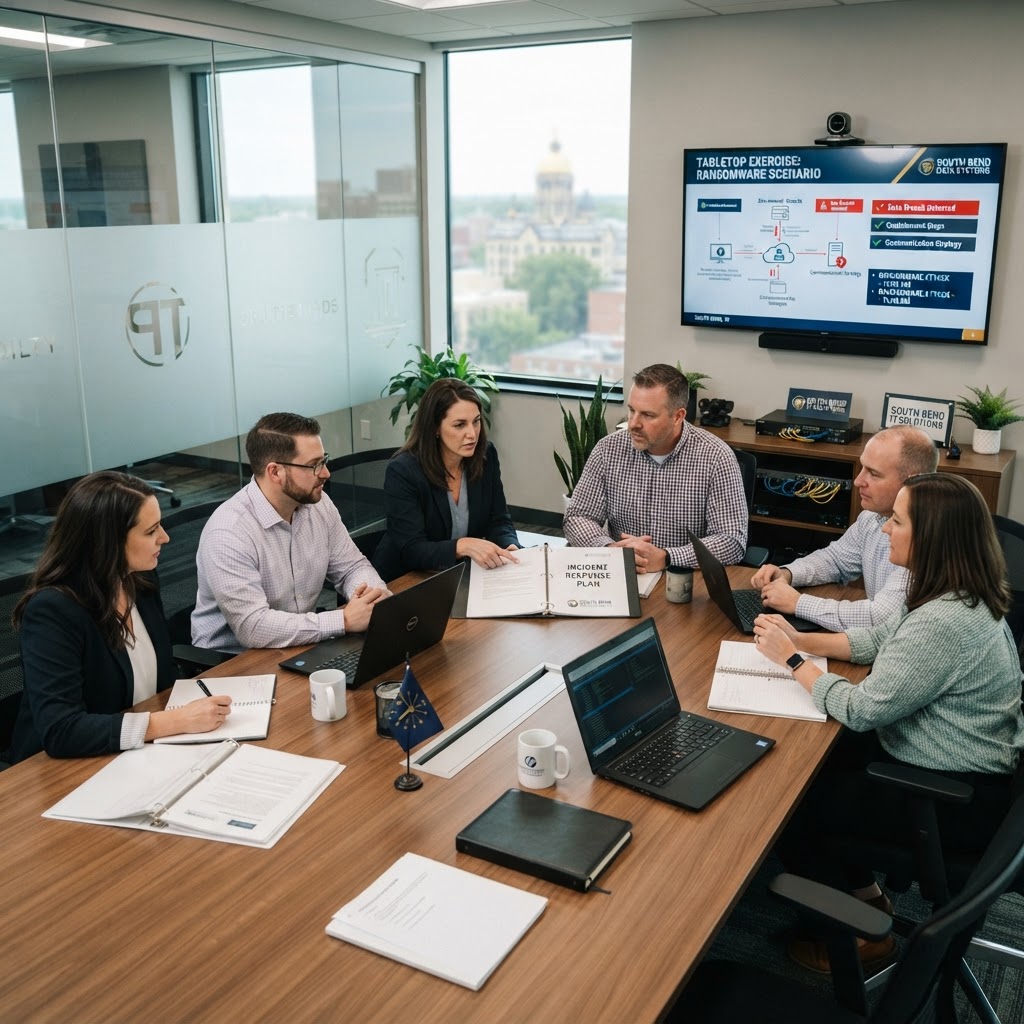
One of the most practical ways to do that is with a 45-minute tabletop exercise. These short, structured sessions help leadership and staff walk through a realistic cyber incident, identify gaps, and improve response without disrupting the workday. For organizations in South Bend, Mishawaka, Elkhart, and across the Michiana region, tabletop exercises offer a manageable way to strengthen cybersecurity while supporting evolving CISA 2.0-style best practices around resilience, coordination, and readiness.
Move Beyond Written Policy With 45-Minute Tabletop Exercises
A strong incident response plan should define roles, escalation paths, communication steps, and recovery priorities. But many small businesses discover a problem only when they try to use the plan: key contacts are outdated, decision-makers are unclear, or no one knows who is authorized to shut down systems, notify customers, or call cyber insurance.
That is where tabletop exercises help. A tabletop exercise is a guided discussion built around a realistic scenario, such as an employee clicking an AI-generated phishing email that launches ransomware across file shares. In just 45 minutes, your team can test whether your incident response planning works in real life.
A simple tabletop format for Michiana SMBs looks like this:
- 5 minutes: Review the scenario and business impact
- 15 minutes: Discuss immediate response steps in the first hour
- 15 minutes: Walk through communication, containment, and legal or vendor notifications
- 10 minutes: Capture lessons learned and assign action items
The goal is not perfection. The goal is clarity. Your team should leave knowing who does what, what systems matter most, and where the plan needs work.
How Tabletop Exercises Support CISA 2.0 Readiness and Contract Requirements
Many organizations hear "standards" and assume they need an enterprise-level security program. In reality, small businesses can make meaningful progress by demonstrating that they have repeatable response processes and that they test them regularly.
CISA-aligned security expectations increasingly emphasize preparation, coordination, and resilience—not just prevention. If your business is part of a manufacturing, logistics, healthcare, education, or professional services supply chain in Northern Indiana, customers may ask about your incident response plan, business continuity measures, and how quickly you can contain a cyber event.
Regular tabletop exercises help you answer those questions with confidence because they provide evidence that:
- Your incident response plan is current
- Internal roles and responsibilities are defined
- Leadership has practiced key decisions before a real incident
- Third-party contacts, such as IT providers, cyber insurance carriers, and legal counsel, are documented
- Lessons learned are tracked and used to improve controls
For SMBs pursuing or protecting supply chain contracts, this matters. A vendor that can show tested incident response planning often appears lower risk than one with a policy document that has never been used.
AI-Driven Ransomware Changes the Speed of Response
Rising AI-driven ransomware threats are especially challenging for smaller organizations because they make attacks more scalable and more believable. Threat actors can now produce better phishing emails, mimic executive writing styles, and automate reconnaissance to find weak points faster.
For a Michiana SMB, the biggest risk is often not the attack itself—it is the delay in decision-making after the attack begins. If employees are unsure how to report suspicious activity, or if leaders are unclear about containment steps, valuable minutes turn into hours.
That is why incident response planning should focus on the first decisions your team must make:
- Who declares a security incident?
- Who contacts your managed IT or cybersecurity partner?
- Which systems must be isolated first?
- How will employees be informed if email is unavailable?
- When do you notify customers, vendors, or regulators?
- How will you verify backups before recovery starts?
By practicing these questions in a tabletop setting, businesses can reduce confusion and keep a ransomware event from becoming a prolonged operational crisis.
A Practical Tabletop Exercise Framework for South Bend and Michiana Businesses
You do not need a large security team to run an effective exercise. Start with one realistic scenario that reflects your actual risk profile. A manufacturer may focus on ransomware affecting production scheduling. A medical office may test a phishing-led account compromise. A professional services firm may simulate a vendor email breach exposing client data.
To get value from the session, include representatives from:
- Leadership or ownership
- Operations
- IT or your managed services provider
- HR
- Finance
- Communications or customer-facing management
Then use these practical steps:
- Choose one clear objective. For example: test ransomware escalation procedures.
- Limit the session to 45 minutes. Short sessions are easier to schedule and repeat.
- Use real names and tools. Review actual contacts, systems, and vendors—not placeholders.
- Document every gap. Missing phone numbers, unclear authority, and backup questions are all useful findings.
- Assign fixes with deadlines. A tabletop without follow-up becomes just a conversation.
- Repeat quarterly. Rotate scenarios so your response capability improves over time.
This approach keeps incident response planning practical and sustainable for busy SMBs. It also helps create a culture where cybersecurity is part of operations, not just an annual compliance task.
If your business in Michiana needs help turning a written plan into a tested, actionable process, The K.A.B. Group can help. Our team works with small and mid-sized organizations to strengthen cybersecurity, improve incident response planning, and run practical tabletop exercises that support resilience, compliance, and customer confidence. Contact The K.A.B. Group to build an incident response program that is ready for real-world threats.