Marketing Automation for Local Businesses: Why Chat-First AI Agents Are Replacing Email Drips
Introduction
Marketing automation for local businesses is changing fast. For years, many small and midsize businesses relied on traditional email drip campaigns to nurture leads, follow up after form submissions, and stay top of mind with potential customers. While email still has a place in a healthy marketing strategy, buyer behavior has shifted toward faster, more conversational communication.
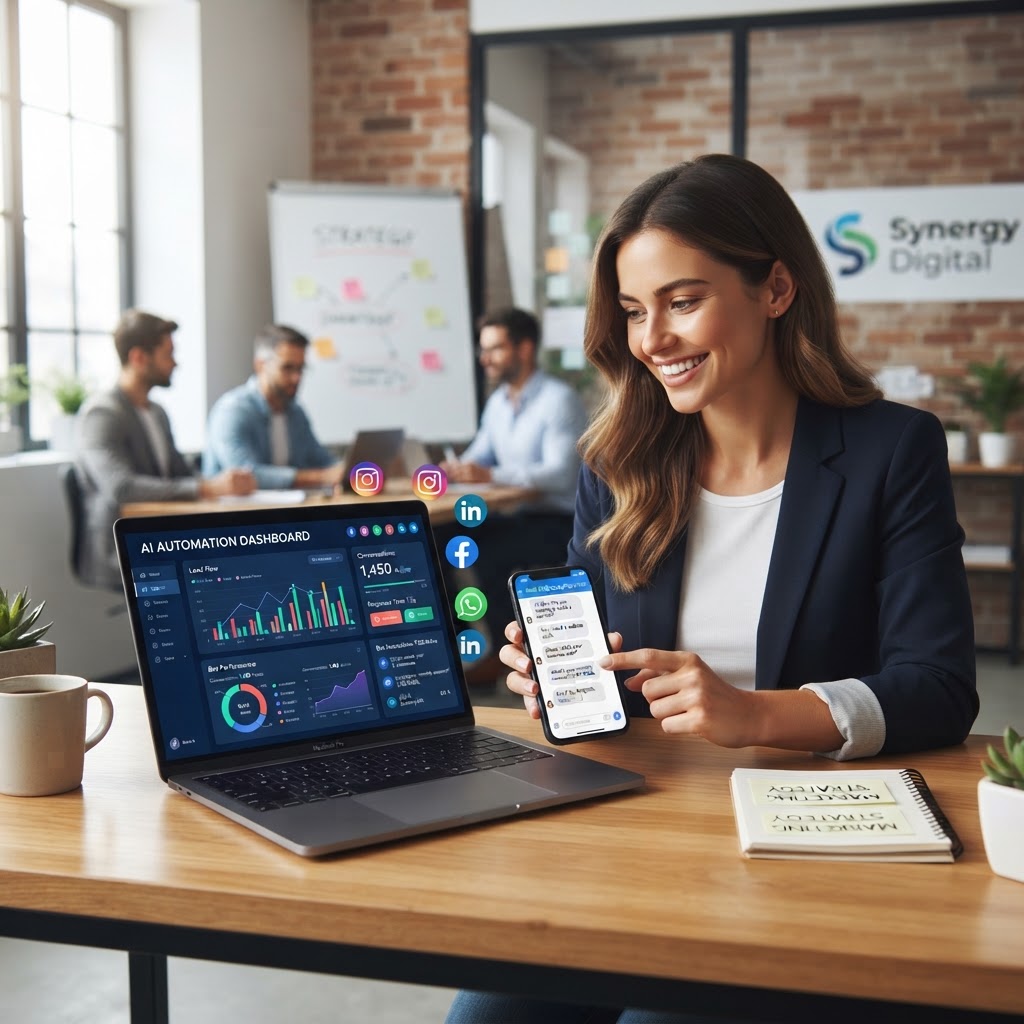
Today’s customers expect quick answers, especially when they are comparing local providers, requesting quotes, or asking about availability. They are more likely to respond to a text message, a Facebook or Instagram direct message, or a website chat than wait for a sequence of scheduled emails. That is why chat-first AI agents are becoming a smarter approach to marketing automation for local businesses. They help teams respond instantly, qualify leads automatically, and move prospects toward action without adding more manual work.
Why Traditional Email Drips Are Losing Effectiveness
Email drip campaigns are useful for long-term nurturing, but they often fall short when speed matters. A prospect who fills out a contact form for a home service, healthcare office, law firm, or retail business usually wants information right away. If the first response is an automated email that sits unread in an inbox, the opportunity can disappear quickly.
Local businesses compete in environments where timing matters. The company that responds first often wins the conversation. Traditional email sequences are not built for real-time engagement. Open rates can be inconsistent, response times are slow, and many messages get buried under promotions and spam filters.
In contrast, chat-first communication meets customers where they already are. SMS, social media messaging, and live website chat feel immediate and convenient. Instead of sending a generic three-email sequence over several days, a chat-first AI agent can ask qualifying questions in real time, collect contact details, answer common questions, and guide the lead to book an appointment or request a quote.
For small-to-medium businesses, this shift is important. Marketing automation should not just send messages. It should create conversations that lead to measurable results.
How Chat-First AI Agents Improve Lead Qualification
One of the biggest benefits of chat-first AI agents is faster, more consistent lead qualification. When a potential customer reaches out, the AI agent can immediately ask practical questions such as location, service need, timeline, budget range, or preferred appointment time. This helps local businesses identify high-intent leads without making customers wait for a callback.
This type of marketing automation for local businesses improves efficiency in several ways:
- Instant response times: Leads receive a reply within seconds, even after hours or on weekends.
- Better customer experience: Prospects get quick answers without sitting in an inbox queue.
- Consistent qualification: Every lead is asked the right questions in the same order.
- Less manual work: Staff spend less time sorting through incomplete inquiries.
- Higher conversion potential: Qualified leads can be routed directly to scheduling, sales, or follow-up.
For example, a local service business can use an AI agent to respond to website and Facebook inquiries, ask what service the customer needs, confirm the service area, and offer available consultation times. A medical practice might use the same approach to guide new patient inquiries. A retailer could answer product or inventory questions and encourage in-store visits.
The real advantage is not just automation for its own sake. It is automation that supports the way customers want to communicate now.
Best Practices for Marketing Automation for Local Businesses
If you are considering replacing or supplementing email drips with chat-first tools, start with a practical plan. The goal is to improve responsiveness without losing the personal touch that matters to SMB customers.
First, identify your highest-value lead sources. Look at where inquiries are coming from today, such as website forms, Google Business Profile clicks, Facebook messages, Instagram DMs, or text campaigns. These channels are often strong candidates for chat-first automation.
Next, define the most important qualification questions. Keep them simple and relevant. Ask only what your team truly needs in order to prioritize, route, or schedule the lead. Too many questions can create friction and reduce conversions.
It is also smart to build clear handoff points. AI agents work best when they manage the early conversation and then pass qualified opportunities to a real person when needed. For example, if a customer asks a complex question, requests custom pricing, or is ready to close, the transition to a staff member should be seamless.
Another best practice is to connect automation with your CRM or scheduling tools. When lead data flows automatically into your systems, your team can follow up faster and track outcomes more accurately. This creates a stronger process from first contact to closed business.
Finally, review performance regularly. Measure response times, conversion rates, appointment bookings, and lead quality by channel. Good marketing automation for local businesses should make your pipeline easier to manage and more profitable over time.
Making the Shift from Email-First to Chat-First
Moving away from an email-first mindset does not mean abandoning email completely. Email still works well for newsletters, post-sale education, promotions, and long-term nurturing. But for new local leads, chat-first engagement is often a better front-line strategy.
A practical approach is to use AI chat and messaging for immediate qualification, then use email for follow-up content and ongoing relationship building. This hybrid model gives local businesses the speed of real-time conversations and the staying power of email when appropriate.
For SMBs, the key is choosing automation that reflects modern customer expectations. People want quick answers, convenient communication, and less friction. Businesses that can deliver that experience are in a stronger position to win more local inquiries and turn them into paying customers.
If your current system depends too heavily on delayed email sequences, now is the time to rethink how your business handles first contact. Faster conversations can lead to better leads, more appointments, and stronger customer trust.
Ready to modernize your marketing automation for local businesses? The K.A.B. Group helps small and midsize businesses implement practical automation strategies, including chat-first AI tools that improve response times, qualify leads faster, and support long-term growth. Contact The K.A.B. Group to build a smarter marketing process that keeps up with how customers connect today.