
Business Continuity Planning for Michiana SMBs in the Age of AI-Driven Cyber Threats
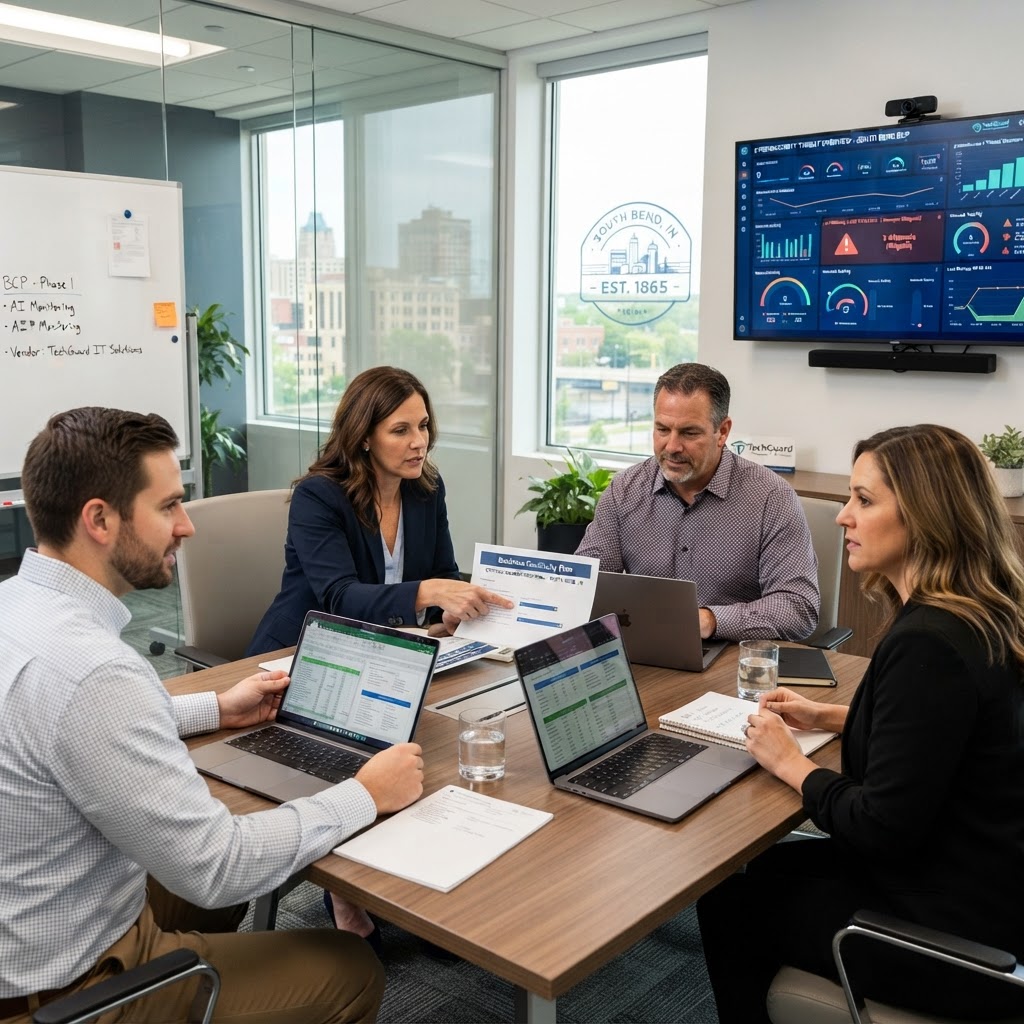
Why Business Continuity Planning Matters More Than Ever
For small and mid-sized businesses in Michiana, business continuity planning is no longer just about recovering from a server outage, severe weather event, or accidental data loss. Today, it also means preparing for fast-moving, AI-driven cyber threats that can disrupt operations in minutes. Automated phishing campaigns, deepfake-style impersonation, and AI-assisted social engineering are making it easier for attackers to target Indiana businesses with convincing messages and fewer errors than ever before.
Many SMBs in South Bend and the surrounding Michiana region still approach cyber incidents reactively: respond after an employee clicks, restore files after damage is done, and sort out communication when operations are already strained. That model is becoming riskier. A stronger approach is to build a business continuity plan that includes proactive, AI-informed incident response protocols designed to detect, contain, and reduce the impact of threats before they become full-scale business disruptions.
From Disaster Recovery to Proactive Incident Response
Traditional disaster recovery focuses on restoring systems after something goes wrong. That remains important, but modern business continuity planning requires more than backups and downtime checklists. In the age of AI-driven cyber threats, SMBs need to think about how incidents start, how quickly they spread, and how decisions will be made in real time.
A proactive incident response strategy helps your business move faster when suspicious activity appears. For example, if an employee receives an urgent payment request that looks like it came from a trusted vendor, your team should already know the verification steps, reporting path, and containment actions. That may include flagging the email, pausing transactions, isolating affected accounts, and notifying internal decision-makers immediately.
For Michiana businesses, this shift is especially valuable because many SMBs operate with lean teams and limited in-house IT resources. A well-documented response plan reduces confusion, shortens downtime, and gives staff clear direction during stressful situations. Instead of relying on memory or improvisation, your business continuity plan becomes a practical playbook for maintaining operations during a cyber event.
How AI-Driven Phishing Is Changing the Threat Landscape
Phishing is not new, but AI is making it more scalable, more believable, and harder to detect. Attackers can now generate polished emails that mimic writing styles, local references, and vendor language with surprising accuracy. For a business in Indiana, that could mean fake messages referencing regional suppliers, local banking relationships, or community organizations in ways that feel legitimate.
This matters because business continuity planning must account for the fact that many disruptions now begin with a single convincing message. One click can lead to credential theft, account compromise, ransomware deployment, or fraudulent wire requests. AI-powered attacks also allow criminals to test variations quickly, improving their success rates over time.
To reduce this risk, SMBs should build practical safeguards into their daily operations:
- Require multi-factor authentication for email, cloud platforms, and financial systems.
- Create approval workflows for payments, account changes, and sensitive data requests.
- Train employees to verify unexpected requests through a second channel, such as a phone call.
- Use email filtering and endpoint protection that can identify suspicious behavior early.
- Document who to contact immediately if phishing or account compromise is suspected.
These steps support both cybersecurity and business continuity. The goal is not just to block threats, but to keep essential operations moving even if an incident occurs.
Core Elements of a Strong Business Continuity Plan for SMBs
An effective business continuity plan should be simple enough to use under pressure and detailed enough to guide action. For SMBs in South Bend and across Michiana, that starts with identifying the systems and workflows that are most critical to serving customers, processing payments, communicating with staff, and maintaining compliance.
Focus on these key components:
Business impact priorities: Identify which functions must stay operational first. This may include email, phones, accounting platforms, line-of-business applications, or customer support systems.
Incident response roles: Define who makes decisions, who contacts your IT provider, who communicates with employees, and who handles customer or vendor updates.
Communication plans: Prepare templates and contact lists in advance so your team can communicate clearly during an outage or cyber incident.
Access and backup strategy: Ensure backups are tested regularly and that critical data can be restored quickly. Just as important, verify that backup access is protected from compromised credentials.
Security controls: Review protections like MFA, patch management, privileged access controls, and endpoint monitoring. These controls help limit the spread of an attack.
Tabletop testing: Run short exercises based on realistic scenarios, such as a phishing email leading to a payroll account compromise. Testing helps employees build confidence and reveals gaps before a real incident does.
Business continuity planning should be reviewed regularly, especially as tools, vendors, staffing, and cyber risks change. A plan that sat untouched for two years may not reflect your current operations or today’s AI-driven threat environment.
Turning Your Plan Into a Day-to-Day Advantage
The most effective business continuity planning does not live in a binder or a forgotten shared folder. It becomes part of how your business operates every day. That means building repeatable security habits, reviewing incident response procedures regularly, and using technology that gives your team better visibility into emerging threats.
For SMBs in Michiana, this can be a competitive advantage. Customers, partners, and insurers increasingly want to know that businesses take resilience seriously. A company that can respond quickly to an incident, protect client information, and maintain service during disruption is better positioned to earn trust and avoid costly downtime.
Start with manageable improvements. Review your phishing defenses. Confirm that leadership knows their role during a cyber incident. Test your backups. Update your vendor verification process. Make sure your employees know how to report suspicious activity without hesitation. Small, consistent changes often have the biggest impact.
If your current approach is mostly reactive, now is the time to strengthen it. The K.A.B. Group helps Michiana businesses build practical business continuity planning strategies, improve incident response readiness, and reduce risk from evolving cyber threats. If you want a clearer, more proactive path to resilience, contact The K.A.B. Group to start the conversation.